Artificial Intelligence (AI) and Machine Learning (ML) are two of the most important technologies driving innovation in today’s digital world. From virtual assistants and recommendation systems to fraud detection and predictive analytics, AI and ML are transforming how businesses solve problems and make decisions.
Although AI and ML are often mentioned together, they are not the same. AI is the broader concept of building systems that can simulate human intelligence. At the same time, ML is a subset of AI that enables systems to learn from data and improve over time without being explicitly programmed for every task.
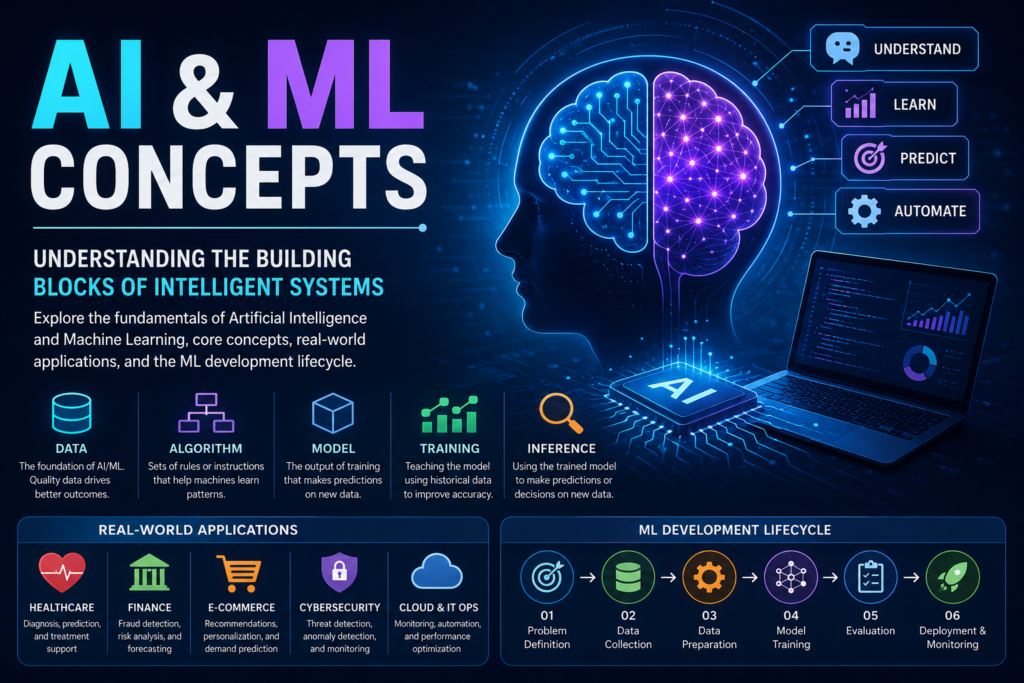
Understanding AI and ML concepts is essential because they form the foundation for modern intelligent systems used across industries such as healthcare, finance, cybersecurity, cloud computing, e-commerce, and automation.
What is Artificial Intelligence (AI)?
Artificial Intelligence refers to the capability of machines or computer systems to perform tasks that normally require human intelligence. These tasks include learning, reasoning, decision-making, problem-solving, recognizing patterns, and understanding language.
In simple terms, AI enables machines to think and act intelligently based on data and programmed logic.
AI systems are designed to:
- Analyze information
- Recognize patterns
- Make predictions
- Solve problems
- Support decision-making
- Automate tasks
For example, voice assistants, chatbots, recommendation engines, and image recognition systems are common examples of AI applications used in everyday life.
What is Machine Learning (ML)?
Machine Learning is a subset of Artificial Intelligence that focuses on enabling machines to learn from data.
Instead of manually programming every rule, machine learning algorithms identify patterns in historical data and use those patterns to make predictions or decisions when new data is introduced.
In traditional programming:
Input + Rules = Output
In machine learning:
Input + Data = Learning Model → Prediction
For example, an email spam filter can learn from thousands of emails and automatically identify spam messages based on patterns in the data.
This ability to improve performance based on data makes machine learning one of the most powerful areas within AI.
AI vs ML: Understanding the Difference
Artificial Intelligence and Machine Learning are related but different concepts.
| Artificial Intelligence (AI) | Machine Learning (ML) |
|---|---|
| Broad field of creating intelligent systems | Subset of AI focused on learning from data |
| Includes reasoning, decision-making, perception, automation | Focuses on pattern recognition and prediction |
| Can use rule-based logic | Learns from training data |
| Goal is intelligent behavior | Goal is improved learning from data |
In short:
AI is the larger field, while ML is one of the technologies used to build AI systems.
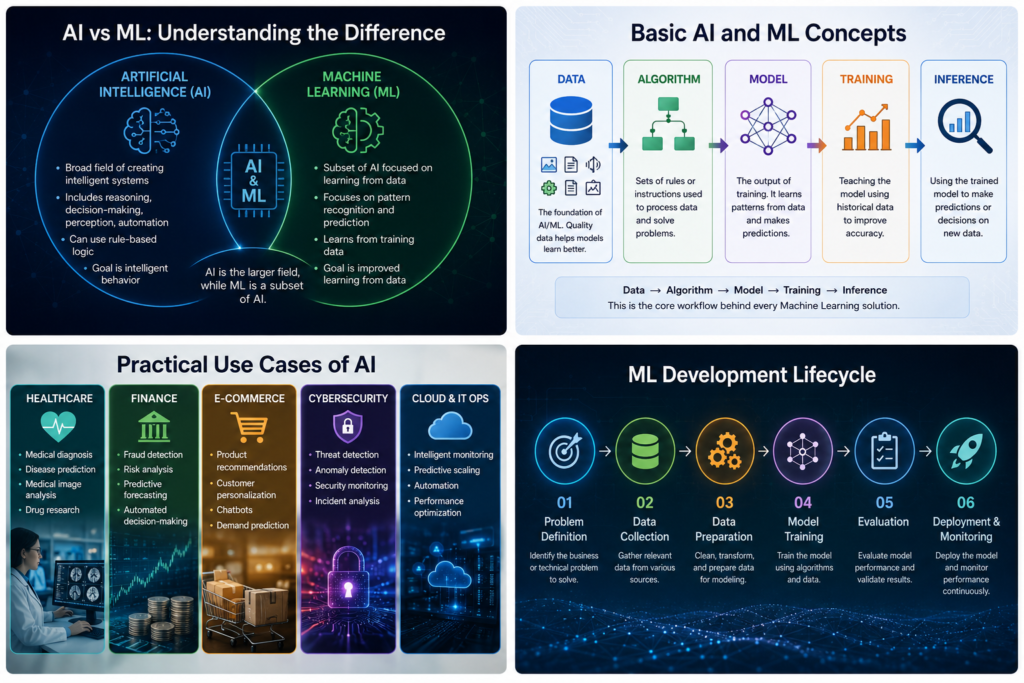
Basic AI and ML Concepts
To understand AI and ML, it is important to know some core concepts.
Data
Data is the foundation of AI and ML systems. Machine learning models use data to identify patterns and make decisions.
Examples of data include:
- Images
- Text
- Audio
- Customer records
- Sensor readings
- Transaction history
High-quality data is essential because the performance of AI systems depends heavily on the data used for training.
Algorithm
An algorithm is a set of mathematical instructions used to process data and solve a problem.
Machine learning algorithms help systems:
- Learn patterns
- Classify information
- Predict outcomes
- Improve decision-making
Examples include regression models, decision trees, clustering algorithms, and neural networks.
Model
A model is the result of training a machine learning algorithm on data.
The model learns relationships and patterns from historical data and uses that learning to make predictions on new data.
For example, a trained model may predict customer behavior, identify fraud, or classify images.
Training
Training is the process of teaching a machine learning model using historical data.
During training:
- Data is provided to the algorithm
- Patterns are identified
- Parameters are adjusted
- Performance improves over time
Inference
Inference is the process of using a trained model to make predictions on new data.
For example, once a fraud detection model is trained, it can analyze a new transaction and determine whether it may be fraudulent.
Practical Use Cases of AI
AI is used in many real-world business and technical applications.
Healthcare
AI helps in:
- Medical diagnosis
- Disease prediction
- Medical image analysis
- Drug research
Finance
AI supports:
- Fraud detection
- Risk analysis
- Predictive forecasting
- Automated decision-making
E-commerce
AI improves:
- Product recommendations
- Customer personalization
- Chatbots
- Demand prediction
Cybersecurity
AI is used for:
- Threat detection
- Anomaly detection
- Security monitoring
- Incident analysis
Cloud and IT Operations
AI supports:
- Intelligent monitoring
- Predictive scaling
- Automation
- Performance optimization
These practical use cases show how AI is becoming an important part of modern business operations.
Machine Learning Development Lifecycle
Machine learning solutions follow a lifecycle from idea to deployment.
1. Problem Definition
The first step is identifying the business or technical problem to solve.
Example:
Can AI predict customer churn?
2. Data Collection
Relevant data is gathered from trusted sources.
The quality and quantity of data directly affect model performance.
3. Data Preparation
Data must be cleaned and prepared before training.
This may include:
- Removing errors
- Handling missing values
- Formatting data
- Organizing features
4. Model Training
Machine learning algorithms are trained using prepared data.
The model learns patterns and relationships from the dataset.
5. Model Evaluation
After training, the model is tested to evaluate performance.
Common evaluation measures include:
- Accuracy
- Precision
- Recall
- Prediction quality
6. Deployment
Once validated, the model is deployed into real-world applications.
It can then begin making predictions or supporting business processes.
7. Monitoring and Improvement
Models must be monitored over time to maintain performance.
As data changes, retraining may be required to improve accuracy and reliability.
Benefits of AI and ML
AI and ML provide several benefits to organizations.
Automation
Reduce repetitive manual tasks.
Better Decision-Making
Analyze large volumes of data quickly.
Improved Efficiency
Increase speed and reduce operational effort.
Predictive Capabilities
Forecast trends and outcomes.
Personalization
Improve customer experience through intelligent recommendations.
Challenges of AI and ML
Despite their advantages, AI and ML also have limitations.
Data Quality Issues
Poor data can lead to poor results.
Bias in Models
Biased data may create unfair outcomes.
Security Risks
AI systems must be protected from misuse and attacks.
Explainability Challenges
Some AI models are difficult to interpret.
Resource Requirements
Advanced AI models may require significant computing power.
Why AI and ML Matter
AI and ML are becoming foundational technologies for digital transformation.
Organizations use them to:
- Improve efficiency
- Reduce operational costs
- Automate processes
- Improve customer experiences
- Build intelligent applications
Cloud platforms such as AWS provide infrastructure and services that help organizations build, train, and deploy AI and ML solutions at scale.
As AI adoption continues to grow, understanding AI and ML concepts is becoming an essential skill for technology professionals.
Conclusion
Artificial Intelligence and Machine Learning are transforming the way organizations solve problems and use data.
AI is the broader concept of creating intelligent systems, while ML is a subset of AI that enables systems to learn from data and improve predictions over time.
By understanding AI concepts, practical use cases, and the machine learning lifecycle, professionals can build a strong foundation for working with modern AI technologies.
As industries continue to adopt intelligent systems, AI and ML knowledge is becoming a critical skill for the future.